

As an observer, researcher, and commentator on the topic of tipping I feel the need to help clarify the nomenclature of the practice by presenting some definitions of frequently used terms.
Tip Sharing: Occurs when management asks servers to ‘share’ tips with other employees, and sometimes management (illegal in some durisdictions). The amount ‘shared’ is most often a percentage of sales for the server and often called the ‘tip out‘. The money is then distributed to other positions in the restaurant usually based on hours worked or a point system. Some restaurants have shares awarded to kitchen staff while others only share with front of house support staff like hosts and bartenders. Most full-service restaurants in Canada using this system ask servers to ‘tip out’ between 3 and 7 percent of their sales.
Tip Pooling: Occurs when tips are not given directly back to the employee who ‘served’ the customer, but instead are consolidated and then divided up amongst staff working that shift that are in the pool. Participants in the pool are determined by management and will most always include all ‘servers’ working that shift. Some restaurants include all employees in the pool, including back of house staff. The use of tip pooling has been increasing in full-service restaurants in recent years and is most always used in businesses that are non-traditional (new to tipping) like counter service establishments, coffee shops etc..
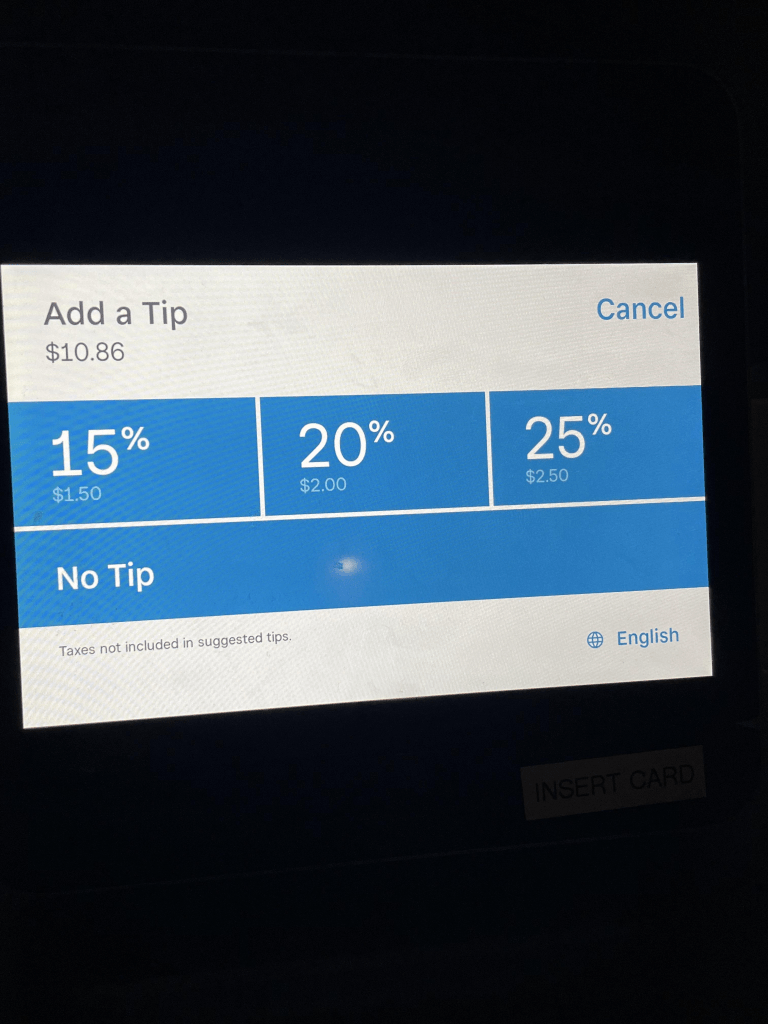
Tip Prompt: Refers to the amount of the pre-set values for tipping that are programed into payment machines. While mostly percentages, some prompts will be in dollar amounts, particularly when dealing with lesser value transactions that you might find in a coffee shop. It should be noted that this has changed the expectation on the total amount the consumer should tip on a purchase. Pre digital payment machines, it was an accepted expectation that consumers tip out on the ‘before tax’ total of a purchase. With digital payment machines, consumers now tip out automatically on the ‘post tax’ amount.
Service Included/Hospitality Included: This is the term used to describe menus in full-service restaurants that have a ‘no gratuity’ policy. When dining in these establishments you will find higher menu prices but these are offset by not having to tip. Restaurants doing this generally offer higher (living) wages and benefit packages to their employees. This is the most popular model outside of North America.
‘Tipflation‘: A recent term used to represent the idea that service providers are asking consumers to leave larger tips then they did in the past. This phenomenon is often associated with ‘tip prompts’ on digital payment machines and consumer feeling that pre-set percentages have been increasing in recent years.
Tip Creep: Used to represent the idea that there has been an influx of non-traditional service providers starting to ask consumers for gratuities. An example of this is how some quick-service restaurant (QSR) companies like Subway now have tip prompts for you to leave a tip. Tip creep has also reached beyond food-service establishments to other businesses like oil lube shops and drycleaners. A list of ‘traditional’ service businesses that have been accepted places to tip are: hair cutting, taxi/Uber, food delivery, and hotel lobby staff.
Tip Fatigue: Another recent term used to summarize consumers feeling of exhaustion, bombardment, guilt, stress, and pressure incurred now that tipping has become more prevalent in daily life. This fatigue is not only generated by these new mental energies and emotions used when having to tip, but also with an increasing skepticism that they are no longer tipping for ‘good service’ but instead providing a ‘wage subsidy’ for service workers. A new contributor to this ‘fatigue’, and ‘cynicism’ is the issue of trust. With the advent of non-traditional businesses asking for tips, and the lack of transparency of who is receiving the tips because of the prevalence of digital payment methods, people are starting to question where their money is going.
I hope you have found list list of terms helpful in gaining a better understanding of the evolution of the practice of tipping. These definitions have been based on my personal experience in studying this topic as well as terms that have become accepted in the industry and repeatedly used in the media. Please note that some establishments and industry participants may have slightly different meanings for these terms, or use other terms to represent what I have put forth. I welcome comments on this effort, please leave below or contact me at bmcadams@uoguelph.ca
Bruce McAdams
Associate Professor, School of Hospitality, Food and Tourism Management, University of Guelph
 University of Guelph Sustainable Restaurant Project